女子遭丈夫打死
US Challenges China's Influence Over Pacific Island Countries, But Does It Have Much to Offer?_我的网站

A | "For decades now, the Pacific Ocean can be fairly described as an American lake, in which the US strategic presence is actively supported by the Australian and to a lesser extent New Zealand economic and security presence," says Joseph Camilleri, emeritus professor at La Trobe University in Melbourne.,However, with the People's Republic of China's (PRC) swift economic rise, it's hardly surprising that Beijing has started to explore new possibilities in the Pacific, according to the academic.,"What has particularly troubled the United States and its principal ally in the South Pacific, Australia, is the fact that China is making inroads into what was until now considered to be an exclusive American sphere of influence," he stresses.,On July 13, Vice President Kamala Harris told the Pacific Islands Forum (PIF) in Suva in a virtual address that US funding for the region would be stepped up to $60 million per year for 10 years. The newly announced endeavor includes more funding for fisheries, extra aid, and offers of new US embassies in the Pacific. In particular, the US is set to ink renewed fishing treaties with Pacific island nations allowing US vessels to fish in their exclusive economic zones (EEZ), and offering greater support for maritime surveillance in the Pacific. In addition to that, the Peace Corps – the United States government's volunteer program – will return to four countries, including Fiji, Tonga, Samoa, and Vanuatu, according to CNN.,Australia Welcomes 'Renewed Commitment' From US Towards Pacific, Willing to Work With China11:38 GMT,"The timing of the pledge has much to do with the strategic competition between the United States and China," Camilleri explains. "In recent years, China has made considerable headway in developing its relations with [the Pacific Island Forum (PIF)] board, including cooperation in political, security and regional affairs, aid and development, COVID response and health, Ocean affairs and climate change, and much else.",The US attempt to assert its presence in the Pacific region also comes on the heels of the Quad IUU Fishing Initiative announced in late May, according to Jay Batongbacal, director of the University of the Philippines Institute for Maritime Affairs and Law of the Sea.,The leaders of the Quad nations — Australia, India, Japan, and the United States – proposed a maritime surveillance initiative to establish a tracking system to combat illegal, unregulated, and unprotected (IUU) fishing. The Quad endeavor may be viewed as an extension of earlier initiatives against China's fishing activities in the South Pacific, according to the academic.,"The South Pacific region is presently one of the richest and most active fishery areas in the world," he highlights.,Why Asia Won't Reject Russia's Hydrocarbons or China's Rare Earths Despite US PressureYesterday, 18:54 GMT,Even if Half of Pacific Islands Ink China Pact, It'll be Beijing's Win,Two months ago, Beijing offered a draft agreement between China and 10 island nations spanning policing, security, fisheries, data, and a free trade zone. Some Pacific leaders have agreed to consider China's trade and security pact, while the others have voiced concerns that their rapprochement with Beijing could antagonize Washington.,"The Chinese proposal to establish a China-Pacific Islands cooperation framework agreement may not yet have won sufficient support but I expect that the Chinese side will persist with its proposal, and that it may be happy to proceed with it, even if only five or six Island states are prepared to sing such an agreement," says Camilleri.,Prior to that, in mid-April, the Chinese and the Solomon Islands governments formally signed a bilateral security agreement regardless of the displeasure voiced by the US, Australia, and New Zealand. Commenting on the pact on June 3, State Councilor and Foreign Minister Wang Yi underscored that its purpose is "to assist the Solomon Islands in maintaining social order." He vehemently denied Western media speculation about China's apparent plans to beef up its military presence in the region.,"China has come to the South Pacific region to build roads and bridges and improve the people’s lives, not to station troops or build military bases," Wang highlighted.,© MANDEL NGANUS President Joe Biden meets with China's President Xi Jinping during a virtual summit from the Roosevelt Room of the White House in Washington, DC, November 15, 2021. US President Joe Biden meets with China's President Xi Jinping during a virtual summit from the Roosevelt Room of the White House in Washington, DC, November 15, 2021. © MANDEL NGAN,US-China Competition for Pacific Islands Region Will Intensify,As the US and China's competition for the resource-rich region unfolds, it all depends on what Washington and Beijing can offer to Pacific island nations, according to Camilleri.,"It is doubtful that the paltry sum of $60 million offered by the United States can even begin to match what China is offering, or that it will greatly impress the Pacific Islands States meeting in Fiji," the professor suggests.,Furthermore, China has made substantial progress in building trade relations with the countries of the region as well as in establishing diplomatic ties with the PIF. The People's Republic was first invited to attend the PIF-related Talk on Establishing Dialogue Partnership held in Suva, Fiji, in 1988. Since 1990, China has attended the Post-Forum Dialogue meetings on a regular basis. In 2003, China announced its willingness to further expand economic ties with PIF member countries as well as to provide funding for the forum's secretariat.,"According to official Chinese figures, from 1992 to 2021, total trade volume between China and Pacific Island Countries (PICs) having diplomatic relations with China grew from $153 million to $5.3 billion, registering an average annual increase of 13% and expanding by over 30 times in 30 years. Similarly, by the end of 2021, China’s direct investment in PICs having diplomatic relations with China had reached $2.72 billion," says Camilleri.,The competition between the United States and its allies on the one hand and China on the other will, if anything, gather pace and intensity in the years to come, the professor says, adding that Beijing's advantage is that "it comes to the table with a much bigger checkbook, and greater opportunities for trade and investment, especially in infrastructure projects."。

B |
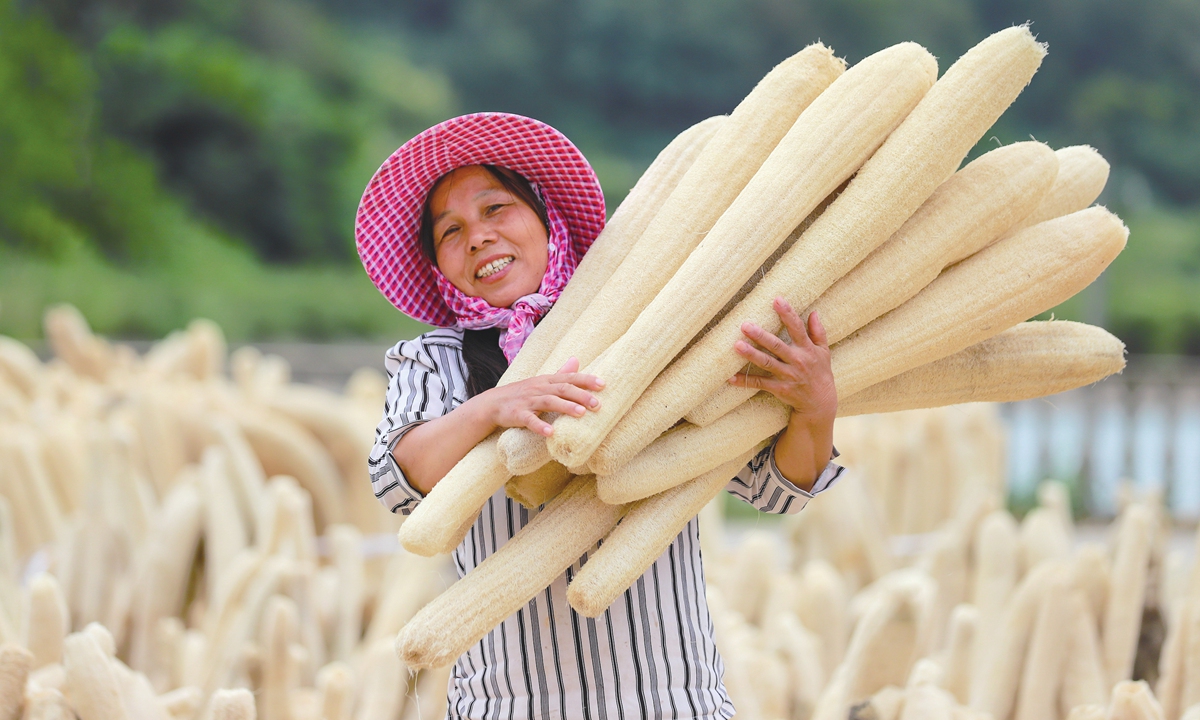
A farmer dries freshly harvested loofah sponges in Fulong township, Jiujiang, East China's Jiangxi Province. File photo: VCG
Chinese plush toys, new-energy vehicles and robots often grab global headlines. Beyond the spotlight, however, many unassuming Chinese exports are quietly making great gains in markets around the world.
Recently, 14,040 specific pathogen free (SPF) eggs, also known as "diamond eggs" and prized as a critical raw material for vaccine research, took off from Beijing Daxing International Airport and landed in Riyadh, Saudi Arabia.
In the first half of 2026 alone, exports of Beijing-produced SPF eggs topped 400,000 units, soaring 254 percent year-on-year. Their export value exceeded 3.8 million yuan ($563,364), up 166 percent year-on-year. Both figures already surpassed the full-year total for 2025, according to statistics from the Beijing customs.
"Diamond eggs" are not alone. Many processed farm goods from various regions across China, ranging from loofahs to new corn-based synthetic fibers to "icy persimmons," are reaching consumers in many countries and regions around the world, with rising export volumes.
Behind the headline numbers lies a quiet change: China is no longer content to ship out raw apples, live fish, or unprocessed grain. It is climbing the value chain - turning farmyard staples into high-value, shelf-ready products for markets around the world, Zhu Qiucheng, CEO of Ningbo New Oriental Electric Industrial Development, told the Global Times.
New e-commerce starsIn Shangcheng County, Central China's Henan Province, the loofahs once lived a quiet life next to the stove - serving as kitchen scrubbers. Today they are a cross-border e-commerce star.
"We have built processing factories, design teams and unified procurement systems that link agricultural cooperatives and farmers across dozens of villages, turning sponge gourds - a traditional side crop - into a scalable, export-oriented industry," a sales manager at Yuangeng Longshang, a local producer and exporter of sponge gourd-related products, told the Global Times.
Processors in Shangcheng have developed more than 60 loofah product lines - ranging from bath sponges and kitchen scrubbers to pet toys and cultural-creative items - and sell them via Amazon, AliExpress, Temu and other platforms to more than 50 countries and regions, according to media reports.
In the first half of 2026, Shangcheng's e-commerce transaction volume of loofah-made products exceeded 30 million yuan, up 35 percent year-on-year. At present, the annual comprehensive output value of the loofah industry in the county has exceeded 100 million yuan.
Apart from sponge gourds, corn has also found a new way to become cloth.
"Unlike traditional synthetic fibers made from petroleum, the core ingredient of our flagship Sorona-based series comes from corn," Hong Boqi, general manager of Chuanyue New Material Co, a domestic cloth supplier, told the Global Times.
The process of making Sorona starts by fermenting corn sugars to extract Bio-PDO (a bio-based chemical building block, essentially a plant-derived version of the molecule used in certain plastics). This is then polymerized and spun into yarn and finished fabric.
The company has independently developed more than 300 Sorona fabric varieties, said Hong.
The firm is also exploring seaweed. Working with a domestic biotech partner, it created an "ice algae mud" functional fabric. Natural seaweed is finely ground and combined with a composite powder made from nephrite, then processed through a specialized spinning method. The finished textile is designed for recycling, reinforcing its green credentials.
Behind these advances lie years of patient research and development. Chuanyue invests about 4 million yuan annually in early-stage material development, covering the full journey from lab innovation to finished fabric, said Hong.
Innovative waysApart from being processed into industrial products, Chinese fresh fruits and vegetables are also processed in innovative ways to reach global consumers.
For example, Hainan Nicepal Industry Co is not simply selling fresh fruit. Instead, it uses advanced spray-drying technology to turn fresh fruits into fruit powders, concentrated juices, and not-from-concentrate (NFC) purees.
Pan Fengying, deputy general manager of the Hainan-based company, said that the company's output value reached 600 million yuan last year, and this year's target is 1.2 to 1.5 billion yuan, according to local media.
And in Yi County, North China's Hebei Province, fresh fruit that once spoiled quickly or fetched rock-bottom seasonal prices is now processed into "icy persimmons," which made exports easier.
In April 2026, the first batch of 15,000 persimmons was sent to Toronto, Canada. In the first half of this year, the sales volume of the ice-ripened persimmons in the county increased eightfold compared to the previous year; the annual production is expected to be 20 times that of last year, local authorities said.
Through controlled processes of de-astringency, sugaring and rapid freezing, the fruit develops a creamy, ice-cream-like texture while retaining its natural sweetness. Local authorities built a shared industrial park complete with standardized workshops, fully automatic production lines and large-scale intelligent cold storage, allowing micro- and small-sized firms to "move in without having to prepare for everything."
The China Agricultural Sector Development Report 2026, released in June, projected a pivot toward higher-value agricultural exports from 2026 to 2030. Categories such as processed fruits and nuts, frozen fruits, fish fillets and frozen vegetables are flagged for strong growth potential.
The message is clear: volume still matters, but value and differentiation matter more.
How did the "sudden" upgrade of the agricultural sector happen? Analysts pointed to two major reasons: pursuit of high-quality development and resilient supply chains.
China has emphasized high-quality development, guiding enterprises to focus more on quality over quantity. This has led to deep processing, brand building and new quality productive forces in the agriculture sector, said Zhu.
Zhu also noted that the speed and completeness of China's resilient supply chains are powering the transformation. Every link - from raw materials to finished goods, including processing, packaging, and logistics - is tightly connected.
。
Current article:http://1nlo32.dinggaxilianmaiyuejienianguai.shop/s76feb/2ypq.html
Published on:18:54:18